Table Of Content
In any case, by using trial reports and screens will help analysts explain to end users’ how this can update and improve their business procedures. If the business decides to implement new technology, then discovery prototyping can help with whether to implement the new technology and to see if it will align with or will be feasible to the company’s business need. In terms of an information system, prototypes are employed to help system designers build an information system that is intuitive and easy to manipulate for end users. Prototyping is an iterative process that is part of the analysis phase of the systems development life cycle.

Systems Analysis and Design: Techniques, Methodologies, Approaches, and Architecture
One can use a template to create a project but with Ad Hoc, it is not possible. Planning the system requires the user to define what the problem is. The planning may also include how the user would like to solve the problem. Defining the scope of the problem is also important in this stage as well.
Dynamic System Models
It is a language used to specify, visualize, and document the artifacts of an object-oriented system under development. You can model just about any type of application running on any type of hardware, operating system, programming language, and network with UML. It is a natural fit for Oject-Oriented languages and environments but you can use it to model non Object-Oriented applications as well. System analysis is used in every field where something is developed. Analysis can also be a series of components that perform organic functions together, such as systems engineering.
Organization
In the modification waterfall model, phases of projects will overlap influencing and depending on each other. During this analysis phase, prototyping usually referred to as the discovery prototypes are very important because it is geared for understanding the users’ needs. [11] The prototypes are not built for full functionality but are built to see if the prototypes are feasible for what goals the business is trying to achieve. Sometimes, end users are trying to improve on the business processes or simplify a procedure.
Information Systems Analysis and Design-Development Life Cycle[edit edit source]
Structured analysis is a traditional systems development technique that is time-tested and easy to understand. Because it describes the processes that transform data into useful information, structured analysis is called a process-centered technique. In addition to modeling the processes, structured analysis includes data organization and structure, relational database design, and user interface issues. Structured analysis uses a series of phases, called the systems development life cycle(SDLC) to plan, analyze, design, implement, and support an information system.Structured analysis relies on a set of process models that graphically describe a system. Process modeling identifies the data flowing into a process, the business rules that transform the data, and the resulting output data flow. MSF uses O-Oanalysis and design concepts, but also examines a broader business and organizational context that surrounds the development of an information system[9].
Sister projects
Cadence develops AI thermal design and analysis platform ... - eeNews Europe
Cadence develops AI thermal design and analysis platform ....
Posted: Thu, 01 Feb 2024 08:00:00 GMT [source]
It is defined by the manner in which the components operate with each other. System Design focuses on how to accomplish the objective of the system. It is a process of collecting and interpreting facts, identifying the problems, and decomposition of a system into its components.
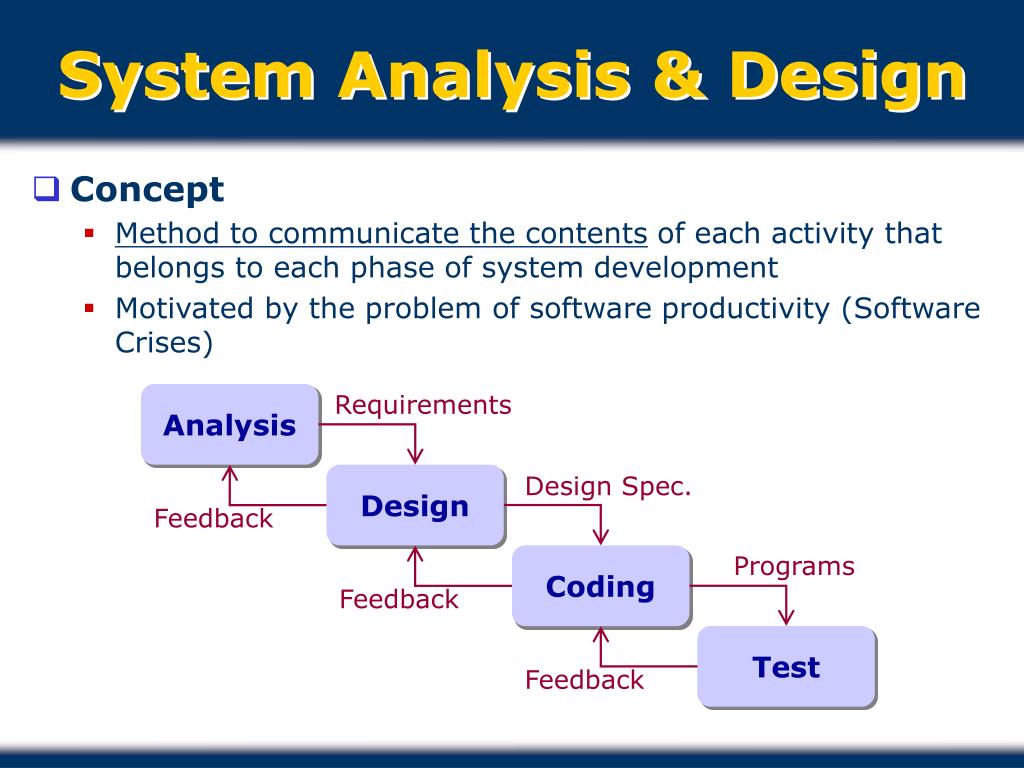
A schedule can be set with deadlines for each stage of development and a product can proceed through the development process like a car in a carwash, and theoretically, be delivered on time. Development moves from concept, through design, implementation, testing, installation, troubleshooting, and ends up at operation and maintenance. Each phase of development proceeds in strict order, without any overlapping or iterative steps. Initiating a project first requires the documenting of needs or requirements.Clear objectives should be developed from this study with reasons for selecting the objectives.Deliverables then need to be documented along with the project scope.
Systems engineering is an interdisciplinary field of engineering that focuses on how complex engineering projects should be designed and managed. It is a process of planning a new business system or replacing an existing system by defining its components or modules to satisfy the specific requirements. Before planning, you need to understand the old system thoroughly and determine how computers can best be used in order to operate efficiently. System analysis is conducted for the purpose of studying a system or its parts in order to identify its objectives. It is a problem solving technique that improves the system and ensures that all the components of the system work efficiently to accomplish their purpose. The disadvantage of waterfall development is that it does not allow for much reflection or revision.
These terms are used in many scientific disciplines, from mathematics and logic to economics and psychology, to denote similar investigative procedures. This tutorial will help budding software professionals to understand how a system is designed in a systematic and phased manner, starting from requirement analysis to system implementation and maintenance. Ad hoc, is something that one can use to do a specific task but the process that was used cannot be used for another process.
Before coding, there should be a understanding on pseudo, algorithm and the high level language(C, C++, C#, Java, etc.) you want to make use of. Modern programming usually requires an object oriented approach to software development. Object-oriented development attempts to use the classifications, relationships, and properties of objects to aid in program development.

The objects contain both attributes and operations that interact to meet a specific need. Attributes are properties that relate to the object and operations are methods or actions that the object can perform to modify itself or data. Access to the data within an object is available only via the objects operation also known as the interface to the object. You can easily alter the details controlling how the object is implemented to improve performance , add new features, or fix bugs without changing the interface. This allows the other parts of the project to access the object and remain unaltered.
This information will become the projects charter and the basis for initiating the project. The project then follows the PLAN-DO CHECK-ACT cycle (as defined by Shewhart and modified by Deming, in the ASQ Handbook, pages 13-14, American Society for Quality, 1999). This process should increase the likelihood of deliverable acceptance. Practitioners of system analysis are often called up to dissect systems that have grown haphazardly to determine the current components of the system. It has been said that if you can not document the artifacts of your work, you will probably fail. The Unified Modeling Language (UML) provides a very robust notation, which grows from analysis to design.
This section discusses the most popular methods for developing computer-based information systems. A popular, traditional method is called structured analysis, but a newer strategy called object-oriented analysis and design also is used widely. Each method offers many variations.Some organizations develop their own approaches or adopt methods offered by software vendors or consultants. Most IT experts agree that no single, best system development strategy exists. Instead, a systems analyst should understand the alternative methods and their strengths and weaknesses.


No comments:
Post a Comment